AI EducademyAIEducademy
🌳

أسس الذكاء الاصطناعي

🌱
AI Seeds

Start from zero

🌿
AI Sprouts

Build foundations

🌳
AI Branches

Apply in practice

🏕️
AI Canopy

Go deep

🌲
AI Forest

Master AI

🔨

إتقان الذكاء الاصطناعي

✏️
AI Sketch

Start from zero

🪨
AI Chisel

Build foundations

⚒️
AI Craft

Apply in practice

💎
AI Polish

Go deep

🏆
AI Masterpiece

Master AI

🚀

جاهز للمسيرة المهنية

🚀
منصة انطلاق المقابلات

ابدأ رحلتك

🌟
إتقان المقابلات السلوكية

أتقن المهارات الشخصية

💻
المقابلات التقنية

تفوّق في جولة البرمجة

🤖
مقابلات الذكاء الاصطناعي وتعلم الآلة

إتقان مقابلات تعلم الآلة

🏆
العرض وما بعده

احصل على أفضل عرض

عرض كل البرامج→

المختبر

تم تحميل 7 تجارب
🧠ملعب الشبكة العصبية🤖ذكاء اصطناعي أم إنسان؟💬مختبر التوجيهات🎨مولّد الصور😊محلل المشاعر💡باني روبوت الدردشة⚖️محاكي الأخلاقيات
🎯مقابلة تجريبيةدخول المختبر→
nav.journeyالمدونة
🎯
عن المنصة

جعل تعليم الذكاء الاصطناعي متاحاً للجميع في كل مكان

❓
الأسئلة الشائعة

Common questions answered

✉️
Contact

Get in touch with us

⭐
مفتوح المصدر

مبني علناً على GitHub

ابدأ الآن
AI EducademyAIEducademy

رخصة MIT. مفتوح المصدر

تعلّم

  • البرامج الأكاديمية
  • الدروس
  • المختبر

المجتمع

  • GitHub
  • المساهمة
  • قواعد السلوك
  • عن المنصة
  • الأسئلة الشائعة

الدعم

  • اشترِ لي قهوة ☕
  • footer.terms
  • footer.privacy
  • footer.contact
البرامج الأكاديمية للذكاء الاصطناعي والهندسة›🌲 AI Forest›الدروس›بناء منتجات الذكاء الاصطناعي
🚀
AI Forest • متقدم⏱️ 20 دقيقة للقراءة

بناء منتجات الذكاء الاصطناعي

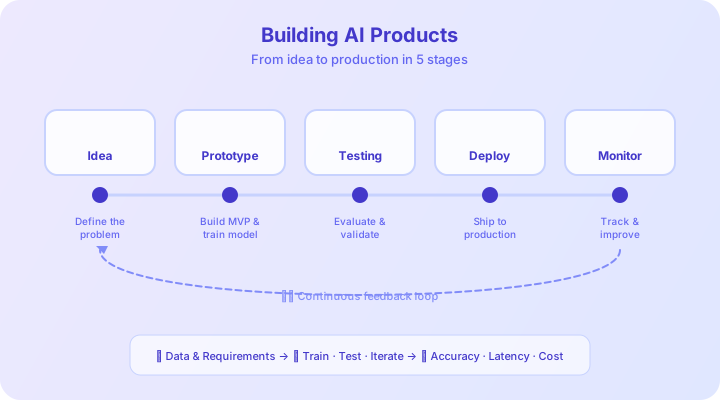
Building AI Products

Most AI projects never make it to production. The gap between a working notebook and a reliable product is enormous - spanning infrastructure, monitoring, team processes, and cost management. This lesson covers everything you need to bridge that gap successfully.

Is AI the Right Solution?

Before writing a single line of code, ask the most important question in AI product development: does this problem actually need AI? The answer is "no" more often than you would think.

AI is the right choice when:

  • The problem involves pattern recognition at scale (fraud detection, image classification)
  • Rules are too complex or numerous to encode manually
  • The data is available, high-quality, and representative of real-world conditions
  • A probabilistic answer (90% confidence) is acceptable
  • The value of automation significantly exceeds the cost of building and maintaining the system

AI is the wrong choice when:

  • Simple rules or heuristics solve the problem reliably
  • You lack sufficient training data
  • Decisions require 100% accuracy with full explainability (some regulatory contexts)
  • The maintenance cost of an ML system outweighs the benefit
💡

The 10x rule: If AI does not deliver at least a 10x improvement over the non-AI alternative in speed, accuracy, or cost, the operational complexity of maintaining an ML system is rarely worth it.

Choosing the Right Model

Not every problem needs a large language model. Choosing the wrong model type is one of the most expensive mistakes in AI product development. Match the tool to the task:

| Problem Type | Best Approach | Example | |---|---|---| | Tabular prediction | Gradient boosted trees (XGBoost, LightGBM) | Churn prediction, pricing | | Image tasks | CNNs or vision transformers | Quality inspection, OCR | | Text classification | Fine-tuned BERT or smaller LLMs | Sentiment analysis, routing | | Generative text | LLMs (GPT-4, Claude, Llama) | Chatbots, content generation | | Time series | Prophet, N-BEATS, or temporal CNNs | Demand forecasting |

🧠فحص سريع

For a tabular churn prediction task with 50,000 rows of structured data, which approach is typically most effective?

الدرس 1 من 100٪ مكتمل
←العودة للبرنامج

Discussion

Sign in to join the discussion

lessons.suggestEdit

Prototyping Fast: The 3-Day Sprint

Speed of iteration beats perfection every time. Teams that spend months building before validating waste resources on assumptions. Use this framework to validate ideas quickly:

Day 1 - Scope and data. Define the single metric that matters. This is non-negotiable - without a clear success metric, you cannot evaluate anything. Gather or simulate the minimum viable dataset. Do not clean it perfectly - just enough to be usable.

Day 2 - Build and test. Use an existing model or API. Wrap it in a minimal interface (Streamlit, Gradio, or a simple API). Get something a human can interact with.

Day 3 - Validate. Put it in front of real users or stakeholders - not colleagues who will be polite, but people who would actually pay for the solution. Measure against your success metric. Decide: kill, pivot, or invest.

🤔
Think about it:

Think about the last AI project you worked on. How long did it take to get the first version in front of a user? Could a 3-day sprint have validated the core idea faster?

MLOps Essentials

Production ML requires rigorous operational practices that most data scientists never learn in academic settings. The core principle is deceptively simple: version everything, automate everything. The execution, however, requires discipline and the right tooling.

What to version:

  • Code - standard Git workflows
  • Data - use DVC, Delta Lake, or similar tools to track dataset versions
  • Models - store model artefacts with metadata (hyperparameters, training data hash, evaluation metrics, and lineage)
  • Configurations - environment variables, feature flags, model parameters, and serving configurations

Pipeline automation:

  • Trigger retraining on schedule or data drift detection
  • Automate evaluation against a held-out test set
  • Gate deployments on performance thresholds
  • Use blue-green or canary deployments for model rollouts
🤯

Google's research found that only about 5% of real-world ML system code is the actual model. The remaining 95% is data pipelines, serving infrastructure, monitoring, and configuration management.

MLOps lifecycle showing data, training, deployment, and monitoring stages
The MLOps lifecycle - continuous improvement, not a one-off deployment

Monitoring: Catching Problems Before Users Do

Deploying a model is not the finish line - it is the starting line. Without proper monitoring, models degrade silently, and by the time someone notices, the damage is already done.

Data drift - The input data distribution shifts over time. A model trained on pre-pandemic shopping data will fail on post-pandemic patterns. Monitor feature distributions continuously and alert on statistically significant shifts using tests like the Kolmogorov-Smirnov test or Population Stability Index.

Model degradation - Even without data drift, model performance can decay as the real world changes. User behaviour evolves, competitors shift the market, and seasonal patterns alter outcomes. Track prediction confidence, error rates, and business metrics continuously.

Key monitoring practices:

  • Log all predictions with inputs, outputs, and confidence scores
  • Set up automated alerts for accuracy drops below defined thresholds
  • Compare live performance against a baseline model on a rolling window
  • Schedule periodic human review of edge cases and low-confidence predictions
  • Track business metrics alongside model metrics - accuracy means nothing if conversions drop
🧠فحص سريع

What is 'data drift' in the context of production ML systems?

Cost Optimisation Strategies

AI inference costs can spiral quickly. Smart architecture decisions keep them manageable.

Practical strategies:

  1. Route by complexity - Use a cheap, fast model for simple queries and escalate to expensive models only when needed. This alone can cut costs by 60-80%.
  2. Cache aggressively - If the same or similar queries recur, cache responses. Semantic caching (matching by meaning, not exact text) is especially effective.
  3. Batch inference - Process non-urgent requests in batches during off-peak hours to maximise GPU utilisation.
  4. Quantise models - 4-bit or 8-bit quantisation can reduce costs by 50-75% with minimal quality loss for most applications.
  5. Right-size infrastructure - Use spot instances for training, reserved instances for serving, and auto-scale based on demand.
🧠فحص سريع

Which cost optimisation strategy involves using different models based on query complexity?

🤔
Think about it:

If you were given a budget of £10,000/month for AI inference, how would you allocate it? Consider which parts of your system need real-time responses versus batch processing, and where caching could eliminate redundant computation.

Key Takeaways

Building AI products is fundamentally a product and engineering challenge, not just a machine learning one. Keep these principles close:

  • Validate that AI is genuinely the right solution before building
  • Match the model type to the problem - LLMs are not always the answer
  • Prototype in days, not months, using existing models and simple interfaces
  • Version everything: code, data, models, and configurations
  • Monitor data drift and model degradation continuously in production
  • Optimise costs through routing, caching, batching, and quantisation

The best AI products are built by teams that understand both the technology and the business problem deeply. Technical excellence without product thinking leads to impressive demos that no one uses.