AI EducademyAIEducademy
🌳

AI 学习路径

🌱
AI 种子

从零开始

🌿
AI 萌芽

打好基础

🌳
AI 枝干

付诸实践

🏕️
AI 树冠

深入探索

🌲
AI 森林

精通AI

🔨

工程技能路径

✏️
AI 草图

从零开始

🪨
AI 雕刻

打好基础

⚒️
AI 匠心

付诸实践

💎
AI 打磨

深入探索

🏆
AI 杰作

精通AI

查看所有学习计划→

实验室

已加载 7 个实验
🧠神经网络游乐场🤖AI 还是人类?💬提示实验室🎨图像生成器😊情感分析器💡聊天机器人构建器⚖️伦理模拟器
进入实验室→
📝

博客

关于AI、教育和技术的最新文章

阅读博客→
nav.faq
🎯
使命

让AI教育触达每一个人、每一个角落

💜
价值观

开源、多语言、社区驱动

⭐
Open Source

在 GitHub 上公开构建

认识创始人→在 GitHub 上查看
立即开始
AI EducademyAIEducademy

MIT 许可证。开源项目

学习

  • 学习计划
  • 课程
  • 实验室

社区

  • GitHub
  • 参与贡献
  • 行为准则
  • 关于
  • 常见问题

支持

  • 请我喝杯咖啡 ☕
AI & 工程学习计划›💎 AI 打磨›课程›转型AI职业
🔀
AI 打磨 • 中级⏱️ 18 分钟阅读

转型AI职业

Career Transitions to AI - From Any Background to AI Engineer

You do not need a PhD in machine learning to work in AI. The field has diversified far beyond research, and companies are actively hiring people who combine technical skills with domain expertise from other fields. This lesson gives you a realistic, actionable roadmap.

The AI Career Landscape

AI is not one job - it is an ecosystem of roles with different skill requirements:

| Role | Core Skills | Typical Background | |------|------------|-------------------| | ML Engineer | Python, PyTorch/TensorFlow, MLOps, system design | Software engineering | | Data Scientist | Statistics, SQL, Python, experimentation | Mathematics, analytics | | AI Researcher | Deep learning theory, paper writing, novel architectures | PhD, academia | | AI Product Manager | Product sense, ML literacy, stakeholder management | Product management | | Prompt Engineer | LLM behaviour, evaluation, prompt design | Writing, engineering | | MLOps Engineer | Kubernetes, CI/CD, model serving, monitoring | DevOps, SRE |

\ud83e\udd2f
According to LinkedIn's 2024 Jobs on the Rise report, "AI Engineer" roles grew 3x faster than general software engineering roles. Prompt engineering did not even exist as a job title before 2022.

Realistic Timelines for Transition

Be honest with yourself about timelines. Rushing leads to impostor syndrome and poor foundations.

  • Software Engineer → ML Engineer: 6-12 months (you already have programming and system design)
  • Data Analyst → Data Scientist: 4-8 months (you already have SQL and analytical thinking)
  • Product Manager → AI Product Manager: 3-6 months (learn ML literacy, not ML engineering)
  • Career Changer (non-tech) → Entry-Level AI Role: 12-24 months (need programming foundations first)

Skills Roadmap by Target Role

ML Engineer Path

  1. Python proficiency - not just scripts, but software engineering practices
  2. Mathematics foundations - linear algebra, calculus, probability (Khan Academy, 3Blue1Brown)
  3. ML fundamentals - Andrew Ng's Machine Learning Specialisation (Coursera)
  4. Deep learning - fast.ai (practical) or Stanford CS231n (theoretical)
  5. MLOps - model deployment, monitoring, CI/CD for ML pipelines
  6. System design for ML - serving, feature stores, A/B testing infrastructure

AI Product Manager Path

  1. ML literacy - understand what models can and cannot do
  2. Data fluency - read metrics dashboards, understand statistical significance
  3. AI ethics - bias, fairness, transparency, responsible AI frameworks
  4. Prototyping - use tools like Hugging Face Spaces or Streamlit to demo ideas
\ud83e\udde0小测验

What is the most realistic timeline for a software engineer to transition to an ML Engineer role?

Transferable Skills - Your Domain Knowledge Is Valuable

Companies do not just need people who understand ML - they need people who understand the problem domain. Your background is an asset:

  • Healthcare professionals → medical AI, clinical NLP, drug discovery
  • Finance analysts → fraud detection, algorithmic trading, risk modelling
  • Teachers/educators → AI tutoring systems, educational content generation
  • Lawyers → legal AI, contract analysis, regulatory compliance
  • Marketers → recommendation systems, personalisation, content generation

The hardest part of AI is not the model - it is understanding the problem deeply enough to frame it correctly.

\ud83e\udd14
Think about it:What domain expertise do you bring from your current or previous roles? How could that knowledge make you uniquely valuable in an AI team working in that domain?

Learning Paths - Choosing Your Route

Self-Study (Free to Low Cost)

  • fast.ai - practical deep learning, top-down approach, free
  • Coursera/edX - structured courses from Stanford, DeepLearning.AI
  • Kaggle - competitions and datasets for hands-on practice
  • Free lectures - Andrej Karpathy, 3Blue1Brown, Yannic Kilcher

Bootcamps (3-6 Months)

  • Intensive, structured, often with career support
  • Cost: £5K-£15K depending on programme
  • Good for career changers who need accountability and networking

Master's Degree (1-2 Years)

  • Best for research-oriented roles or career changers from non-technical fields
  • Consider part-time programmes if you are working (Georgia Tech OMSCS is £6K total)
  • The credential helps most for your first AI role
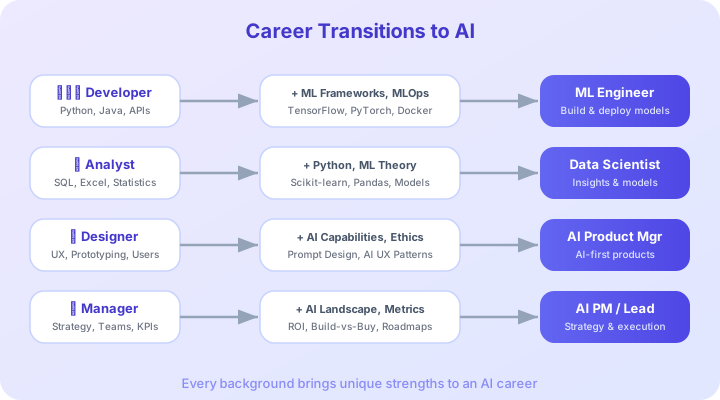
Career transition flowchart showing paths from different backgrounds to various AI roles
Multiple paths lead to AI careers - your starting point determines the fastest route

Building a Portfolio Without Work Experience

If you have no professional AI experience, your portfolio is your resume:

  1. End-to-end projects - not just model training, but data collection, preprocessing, deployment, and a live demo
  2. Kaggle competitions - a top 10% finish in a relevant competition demonstrates real skill
  3. Reproduce a paper - pick a recent paper and implement it from scratch. Write about what you learnt.
  4. Solve a real problem - build something useful: a classifier for your hobby, an NLP tool for your community, a forecasting model for local data

Each project should have a polished GitHub repo with a clear README, clean code, and ideally a deployed demo (Hugging Face Spaces, Streamlit Cloud, or Vercel).

Contributing to Open Source as a Bridge

Open-source contributions prove you can work in real codebases with real teams:

  • Hugging Face - contribute models, datasets, or documentation
  • scikit-learn - beginner-friendly issues labelled "good first issue"
  • LangChain / LlamaIndex - fast-growing projects that welcome contributors
  • Documentation PRs - fixing docs is a legitimate, valuable contribution
\ud83e\udde0小测验

What is the most effective way to build an AI portfolio without professional experience?

Networking Strategies

  • Attend local meetups - AI/ML meetups exist in every major city
  • Engage on social media - share what you are learning on LinkedIn and Twitter/X
  • Join communities - MLOps Community (Slack), Kaggle forums, Hugging Face Discord
  • Cold outreach - message people whose career path you admire. Be specific: "I read your blog post about X and I would love to ask about Y"

Your First AI Job - What to Expect

Your first AI role will likely involve more data wrangling and infrastructure than model building. That is normal. Expect to spend time on:

  • Data quality and preprocessing (60-70% of the work)
  • Building evaluation pipelines and metrics
  • Integrating models into existing systems
  • Learning the company's specific domain and data
\ud83e\udde0小测验

According to this lesson, what percentage of an AI engineer's time is typically spent on data quality and preprocessing?

Career Stories From Non-Traditional Backgrounds

  • A former teacher became an AI product manager at an edtech company because she understood how students actually learn - something no ML engineer could replicate.
  • A mechanical engineer transitioned to ML engineering at a robotics startup. His understanding of physical systems gave him an edge in building simulation environments.
  • A journalist moved into NLP research because her deep understanding of language, bias, and narrative structure was exactly what the team needed.

Your background is not a handicap - it is a differentiator.

\ud83e\udd14
Think about it:Map out your 6-month transition plan. What will you learn in months 1-2, 3-4, and 5-6? What portfolio project will you complete? Who will you reach out to for guidance?

📚 Further Reading

  • fast.ai Practical Deep Learning - Free, practical, top-down deep learning course
  • ML Engineer Roadmap by Chip Huyen - Comprehensive guide to the ML engineering skill set
  • Georgia Tech OMSCS - Affordable online Master's in Computer Science with ML specialisation
第 9 课,共 10 课已完成 0%
←薪资基准
打造个人品牌→