AI EducademyAIEducademy
AcademicsLabBlogAbout
Sign In
AI EducademyAIEducademy

Free AI education for everyone, in every language.

Learn

  • Academics
  • Lessons
  • Lab
  • Dashboard
  • About

Community

  • GitHub
  • Contribute
  • Code of Conduct

Support

  • Buy Me a Coffee โ˜•

Free AI education for everyone

MIT Licence. Open Source

Programsโ€บ๐Ÿชจ AI Chiselโ€บLessonsโ€บTwo Pointers & Sliding Window โ€” How AI Scans Data
๐Ÿ‘†
AI Chisel โ€ข Intermediateโฑ๏ธ 20 min read

Two Pointers & Sliding Window โ€” How AI Scans Data

Two Pointers & Sliding Window

These two patterns let you solve problems in O(n) that most people brute-force in O(nยฒ). They share a core idea: maintain a smart window into the data instead of re-scanning it.


Pattern 1: Two Pointers

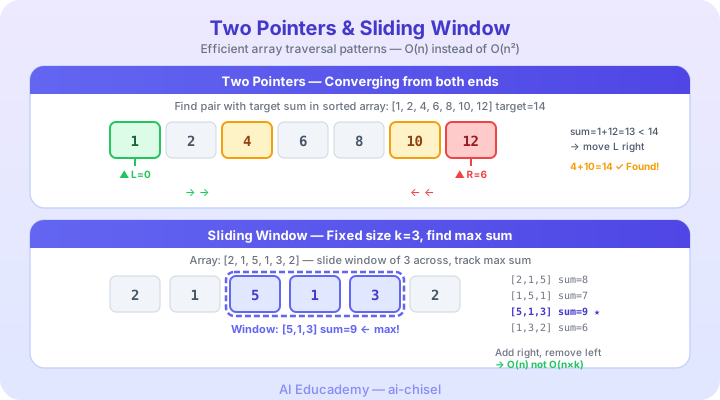
Place one pointer at each end of a sorted array. Move them inward based on a condition.

Two pointers L and R converging on a sorted array to find a target sum
Two pointers converging: compare sum to target, move L right if too small, R left if too big.

When to use it

  • Sorted array + looking for a pair/condition
  • Reducing O(nยฒ) pair searches to O(n)
  • Partitioning (Dutch National Flag)

The algorithm

def two_sum_sorted(arr, target):
    left, right = 0, len(arr) - 1

    while left < right:
        current_sum = arr[left] + arr[right]
        if current_sum == target:
            return [left, right]
        elif current_sum < target:
            left += 1       # need bigger sum
        else:
            right -= 1      # need smaller sum

    return [-1, -1]
๐Ÿ’ก

Key invariant: Everything to the left of L is too small. Everything to the right of R is too big. The answer must be between them.

Classic problems

| Problem | Trick | Complexity | |---------|-------|------------| | Two Sum (sorted) | Converge on target | O(n) | | Container with Most Water | Move the shorter wall inward | O(n) | | 3Sum | Fix one, two-pointer the rest | O(nยฒ) | | Remove Duplicates (sorted) | Slow/fast pointer | O(n) |


Pattern 2: Sliding Window

Maintain a window [left, right] that slides across the array. Expand right, shrink left โ€” never re-scan the window.

A sliding window of size k moving across an array tracking the running sum
Fixed-size window slides right: subtract the leaving element, add the entering element. O(n) total.

Two variants

Fixed-size window (size k):

def max_sum_subarray(arr, k):
    window_sum = sum(arr[:k])
    max_sum = window_sum

    for i in range(k, len(arr)):
        window_sum += arr[i] - arr[i - k]  # slide: add new, remove old
        max_sum = max(max_sum, window_sum)

    return max_sum

Variable-size window (expand/shrink):

def longest_substring_no_repeat(s):
    seen = set()
    left = max_len = 0

    for right in range(len(s)):
        while s[right] in seen:
            seen.remove(s[left])
            left += 1              # shrink window
        seen.add(s[right])
        max_len = max(max_len, right - left + 1)

    return max_len
๐Ÿค”
Think about it:

Why does the variable window still run in O(n)? Each element is added to the set once and removed at most once โ€” that's 2n operations total.

Classic problems

| Problem | Window Type | Key Insight | |---------|-------------|-------------| | Max sum subarray of size k | Fixed | Slide and track sum | | Longest substring without repeats | Variable | Expand right, shrink left on duplicate | | Minimum window substring | Variable | Shrink when all chars found | | Max consecutive ones (k flips) | Variable | Shrink when flips exceed k |


AI Connection: Streaming Data Processing

๐Ÿคฏ

These aren't just interview patterns โ€” they're how production ML systems work:

  • Sliding window in ML: Feature extraction over time-series data (e.g., "average CPU usage over last 5 minutes") uses the exact same fixed-window technique.
  • Two pointers in search: Merge operations in distributed sorting (MapReduce) use two-pointer merging on sorted partitions.
  • Streaming analytics: Apache Kafka and Flink process infinite data streams using sliding and tumbling windows โ€” the same O(n) single-pass logic.
  • Attention mechanisms: Sliding window attention in transformers (e.g., Longformer) limits which tokens attend to each other using a fixed-size window.

Quick Reference

| Pattern | When | Time | Space | |---------|------|------|-------| | Two Pointers (converge) | Sorted array, find pair | O(n) | O(1) | | Two Pointers (fast/slow) | Linked list cycle, partitioning | O(n) | O(1) | | Fixed Sliding Window | Subarray of exact size k | O(n) | O(1) | | Variable Sliding Window | Longest/shortest subarray with condition | O(n) | O(k) |

Lesson 1 of 30 of 3 completed
โ†Back to programTrees & Graphs โ€” How AI Makes Decisionsโ†’