AI EducademyAIEducademy
🌳

AI की नींव

🌱
AI Seeds

शून्य से शुरू करें

🌿
AI Sprouts

नींव बनाएं

🌳
AI Branches

व्यवहार में लागू करें

🏕️
AI Canopy

गहराई में जाएं

🌲
AI Forest

AI में महारत हासिल करें

🔨

AI में महारत

✏️
AI Sketch

शून्य से शुरू करें

🪨
AI Chisel

नींव बनाएं

⚒️
AI Craft

व्यवहार में लागू करें

💎
AI Polish

गहराई में जाएं

🏆
AI Masterpiece

AI में महारत हासिल करें

🚀

करियर रेडी

🚀
इंटरव्यू लॉन्चपैड

अपनी यात्रा शुरू करें

🌟
व्यवहारिक इंटरव्यू में महारत

सॉफ्ट स्किल्स में महारत

💻
तकनीकी इंटरव्यू

कोडिंग राउंड में सफल हों

🤖
AI और ML इंटरव्यू

ML इंटरव्यू में महारत

🏆
ऑफर और उससे आगे

सबसे अच्छा ऑफर पाएं

सभी कार्यक्रम देखें→

लैब

7 प्रयोग लोड हुए
🧠न्यूरल नेटवर्क प्लेग्राउंड🤖AI या इंसान?💬प्रॉम्प्ट लैब🎨इमेज जनरेटर😊सेंटिमेंट एनालाइज़र💡चैटबॉट बिल्डर⚖️एथिक्स सिमुलेटर
🎯मॉक इंटरव्यूलैब में जाएँ→
nav.journeyब्लॉग
🎯
हमारे बारे में

हर जगह, हर किसी के लिए AI शिक्षा सुलभ बनाना

❓
nav.faq

Common questions answered

✉️
Contact

Get in touch with us

⭐
ओपन सोर्स

GitHub पर सार्वजनिक रूप से निर्मित

सीखना शुरू करें - यह मुफ्त है
AI EducademyAIEducademy

MIT लाइसेंस - ओपन सोर्स

सीखें

  • कार्यक्रम
  • पाठ
  • लैब

समुदाय

  • GitHub
  • योगदान करें
  • आचार संहिता
  • हमारे बारे में
  • सामान्य प्रश्न

सहायता

  • कॉफ़ी खरीदें ☕
  • footer.terms
  • footer.privacy
  • footer.contact
AI और इंजीनियरिंग प्रोग्राम›🏆 ऑफर और उससे आगे›पाठ›Tech Offer Negotiate करना
💰
ऑफर और उससे आगे • मध्यम⏱️ 15 मिनट पढ़ने का समय

Tech Offer Negotiate करना

Negotiating Your Tech Offer - Data-Driven Strategies That Work

You have passed the interviews, impressed the panel, and received an offer. Now comes the moment most engineers dread: negotiation. But here is the truth - negotiation is expected, recruiters budget for it, and failing to negotiate is the most expensive mistake you can make in your career.

Why Negotiation Is Expected

Recruiters do not extend their best offer first. Every company has a compensation band for each role - a range from the minimum they will pay to the maximum they have budgeted. The initial offer is almost always in the lower half of that band.

This is not adversarial. It is how the system works. Recruiters expect a counter-offer. When you accept without negotiating, you are leaving money on the table - often £5,000 to £20,000 per year.

💡

A single negotiation that increases your base salary by £8,000 compounds to over £150,000 in additional lifetime earnings when you factor in future raises, bonuses, and pension contributions that are all calculated as percentages of your base.

Know Your Market Rate

You cannot negotiate effectively without data. Before any negotiation, research your market value using multiple sources.

Levels.fyi - The gold standard for tech compensation data. Covers base, bonus, and equity broken down by company, level, and location.

Glassdoor - Broader coverage, especially for non-FAANG companies. Use the salary insights for your specific role and region.

Blind - Anonymous professional network where engineers share verified compensation. Particularly useful for UK and European data points.

Your own network - Ask trusted peers and mentors. People are more willing to share salary information than you might think, especially in private conversation.

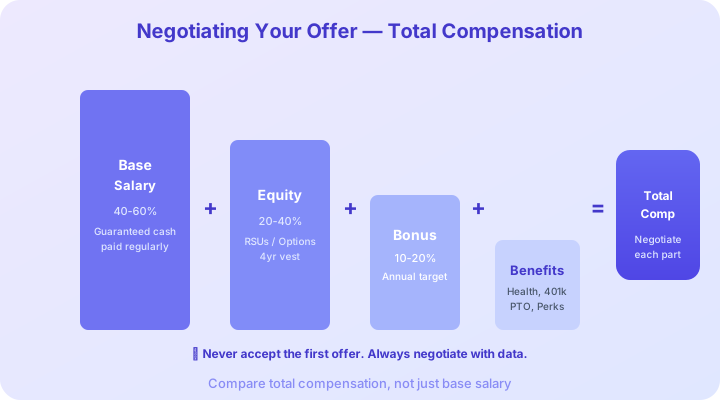
A chart showing the components of total compensation: base salary, bonus, equity, and benefits stacked as layers
Total compensation is more than your base salary - understand every component.

Build a range: Gather at least five data points for your role, level, and location. Calculate the 25th, 50th, and 75th percentiles. Your target should be the 60th to 75th percentile - ambitious but defensible.

🧠त्वरित जांच

Why do recruiters typically not extend their best offer first?

पाठ 1 / 60% पूर्ण
←प्रोग्राम पर वापस

Discussion

Sign in to join the discussion

lessons.suggestEdit

Total Compensation: Understanding the Full Package

Base salary is the most visible number, but it is often not the most valuable. Understand every component:

| Component | What It Means | Negotiable? | |-----------|--------------|-------------| | Base salary | Fixed annual pay | Yes - usually the first thing to negotiate | | Annual bonus | Performance-based percentage of base | Sometimes - target percentage may be fixed | | Equity/RSUs | Company shares vesting over time | Yes - often the most flexible component | | Sign-on bonus | One-time payment to offset opportunity cost | Yes - especially when switching from equity elsewhere | | Pension match | Employer contribution to retirement | Sometimes - depends on company policy | | Benefits | Health, dental, life insurance | Rarely - but worth understanding the value | | Learning budget | Training, conferences, certifications | Often - and frequently overlooked |

🤯

At many major tech companies, equity can represent 40-60% of total compensation at senior levels. An engineer who negotiates only base salary and ignores equity may be optimising the smaller part of their package.

The Negotiation Conversation: Scripts and Tactics

Negotiation does not require aggression or theatrics. It requires preparation, data, and calm confidence.

The Counter-Offer Script

When you receive the offer, do not respond immediately. Thank them and ask for time:

"Thank you - I am genuinely excited about this opportunity. I would like to take a couple of days to review the full package. Could you send the details in writing?"

After reviewing, deliver your counter:

"I have done thorough research on compensation for this role and level. Based on market data from Levels.fyi and conversations with peers, the range for this position in London is £95,000 to £115,000. Given my experience with [specific relevant achievement], I believe £110,000 reflects my market value. Is there flexibility on the base?"

Key Tactics

Anchor high but reasonably. Your counter should be at the top of the defensible range, not absurdly above it. This gives room to meet in the middle at your target.

Use silence. After stating your counter, stop talking. The urge to fill silence with justification weakens your position. Let them respond.

Never lie. Do not fabricate competing offers or inflate your current salary. If caught - and recruiters do verify - you lose the offer entirely.

Negotiate the package, not just the salary. If base salary is capped, ask about equity, sign-on bonus, or remote work flexibility.

🤔
Think about it:

Practise your counter-offer script out loud right now. Say the words. It feels awkward the first time - that is exactly why you practise. By the third repetition, it will feel natural.

Multiple Offers: Leveraging Competing Bids

Having more than one offer is the strongest negotiating position you can be in.

Be transparent, not manipulative. You do not need to reveal exact numbers. Simply stating "I have received a competing offer at a similar level" is sufficient to signal that the company needs to move.

Time your job search. Try to align interview processes so offers arrive within the same two-week window. This requires planning - start applications in batches.

Do not bluff. If you claim to have a competing offer and the company calls your bluff by asking for details or a deadline, you need to be able to back it up.

🧠त्वरित जांच

What is the most effective way to use a competing offer in negotiation?

Beyond Salary: The Hidden Levers

When base salary hits a ceiling, explore these often-overlooked negotiation levers:

Remote work flexibility. Fully remote or hybrid can save £3,000 to £8,000 per year in commuting costs alone, plus the value of reclaimed time.

Title. A higher title - Senior Engineer instead of Engineer, Staff instead of Senior - compounds in future roles. It is free for the company and valuable for you.

Learning budget. An extra £2,000 to £5,000 per year for conferences, courses, and certifications is easy for companies to approve and directly accelerates your career.

Equity refresh. Ask about the equity refresh policy - how and when additional grants are made beyond your initial package.

Start date flexibility. Negotiating a later start date to take a proper break between roles protects your wellbeing and costs the company nothing.

🤯

A survey by Hired found that 73% of tech professionals who negotiated received a better offer than the initial one - and only 2% had their offer rescinded as a result. The risk of negotiating is dramatically lower than most people fear.

When NOT to Negotiate

Negotiation is almost always appropriate, but there are exceptions:

  • Standardised programmes. Graduate schemes and rotational programmes often have fixed, non-negotiable compensation. Pushing here signals that you have not done your research.
  • The offer is already above your range. If the initial offer exceeds the 75th percentile of your research, accept gracefully. Pushing further risks appearing greedy.
  • You have been explicitly told the offer is final. Some companies, particularly in the public sector, have rigid pay bands. Respect that boundary.
  • The relationship matters more. If you are joining a tiny startup founded by a close friend, the dynamics are different from negotiating with a large corporation.
🤔
Think about it:

Think about your last job offer. Did you negotiate? If not, estimate how much you might have left on the table based on the market data for your role. Use that number as motivation for next time.

🧠त्वरित जांच

In which situation is it generally NOT appropriate to negotiate a tech offer?

Key Takeaways

  • Negotiation is expected. Recruiters budget for it. Failing to negotiate leaves real money on the table.
  • Lead with data. Use Levels.fyi, Glassdoor, and your network to build a defensible range.
  • Negotiate the whole package. Base, equity, sign-on, remote flexibility, title, and learning budget are all on the table.
  • Practise your scripts. Negotiation is a skill. Rehearse until the words feel natural.
  • The risk is low. The vast majority of negotiations result in a better offer. Almost none result in a rescinded one.