AI EducademyAIEducademy
🌳

AI基础

🌱
AI 种子

从零开始

🌿
AI 萌芽

打好基础

🌳
AI 枝干

付诸实践

🏕️
AI 树冠

深入探索

🌲
AI 森林

精通AI

🔨

AI精通

✏️
AI 草图

从零开始

🪨
AI 雕刻

打好基础

⚒️
AI 匠心

付诸实践

💎
AI 打磨

深入探索

🏆
AI 杰作

精通AI

🚀

职业准备

🚀
面试发射台

开启你的旅程

🌟
行为面试精通

掌握软技能

💻
技术面试

通过编程轮次

🤖
AI与ML面试

ML面试精通

🏆
Offer与未来

拿下最好的Offer

查看所有学习计划→

实验室

已加载 7 个实验
🧠神经网络游乐场🤖AI 还是人类?💬提示实验室🎨图像生成器😊情感分析器💡聊天机器人构建器⚖️伦理模拟器
🎯模拟面试进入实验室→
学习旅程博客
🎯
关于

让AI教育触达每一个人、每一个角落

❓
常见问题

Common questions answered

✉️
Contact

Get in touch with us

⭐
Open Source

在 GitHub 上公开构建

立即开始
AI EducademyAIEducademy

MIT 许可证。开源项目

学习

  • 学习计划
  • 课程
  • 实验室

社区

  • GitHub
  • 参与贡献
  • 行为准则
  • 关于
  • 常见问题

支持

  • 请我喝杯咖啡 ☕
  • 服务条款
  • 隐私政策
  • 联系我们
AI & 工程学习计划›⚒️ AI 匠心›课程›系统设计基础
🏗️
AI 匠心 • 高级⏱️ 20 分钟阅读

系统设计基础

Why System Design Matters

Every large-scale application is assembled from the same fundamental building blocks. Interviewers don't expect you to invent new technology - they want to see you select and combine the right components for a given problem. This lesson covers the toolkit you'll reach for in every design interview.

Client-Server Architecture

At its core, the web follows a simple model: clients send requests, servers process them, and responses flow back. But modern systems add layers between these two endpoints to handle scale, reliability, and performance.

A typical request might traverse: client → CDN → load balancer → API gateway → application server → cache → database. Each layer solves a specific problem, and understanding when each layer is needed separates strong candidates from average ones.

💡

In interviews, always start by sketching the high-level client-server flow before diving into specifics. It shows structured thinking.

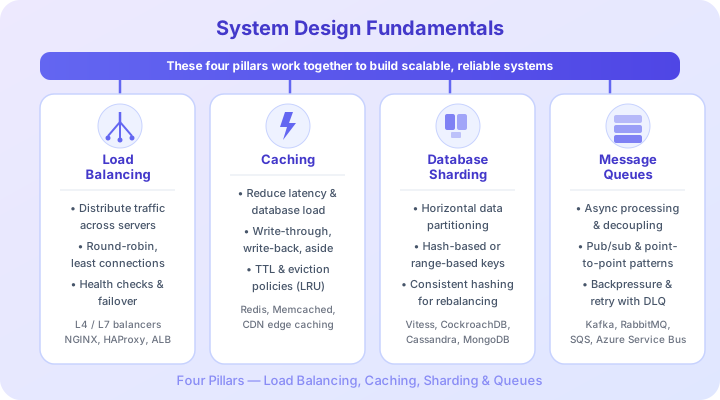
Load Balancers: Distributing Traffic

A single server has finite capacity. Load balancers distribute incoming requests across multiple servers using strategies like:

  • Round-robin - requests cycle through servers sequentially
  • Least connections - routes to the server handling the fewest active requests
  • Consistent hashing - maps requests to specific servers based on a key (useful for caching)

Load balancers also perform health checks, automatically removing unhealthy servers from the pool. In cloud environments, services like AWS ALB or Azure Front Door handle this transparently.

🧠小测验

A social media feed service receives 10x more reads than writes. Which load balancing approach best ensures users consistently hit the same cache-warm server?

Caching: Speed at Every Layer

Caching stores frequently accessed data closer to the consumer. It exists at multiple levels:

| Layer | Example | Latency | |-------|---------|---------| | Browser cache | Static assets, API responses | ~0ms | | CDN | Images, CSS, JS files | ~10-50ms | | Application cache | Redis, Memcached | ~1-5ms | | Database cache | Query result cache | ~5-10ms |

Cache invalidation is famously one of the hardest problems in computing. Common strategies include , (update cache on every write), and (application manages cache explicitly).

第 1 课,共 10 课已完成 0%
←返回学习计划

Discussion

Sign in to join the discussion

建议修改本课内容
TTL (time-to-live)
write-through
cache-aside
🤯

Phil Karlton's famous quote - "There are only two hard things in Computer Science: cache invalidation and naming things" - is so widely cited that it's practically a rite of passage in system design interviews.

Databases: SQL vs NoSQL

Choosing the right database is one of the most impactful design decisions:

SQL databases (PostgreSQL, MySQL) offer ACID transactions, strong consistency, and structured schemas. They excel when data has clear relationships and you need complex queries with joins.

NoSQL databases come in several flavours:

  • Document stores (MongoDB) - flexible schemas, great for varied data structures
  • Key-value stores (DynamoDB, Redis) - blazing fast lookups by key
  • Wide-column stores (Cassandra) - massive write throughput, distributed by design
  • Graph databases (Neo4j) - relationship-heavy data like social networks
🧠小测验

You're designing a system that stores user profiles with frequently changing, semi-structured data (different fields per user type). Which database type is the strongest fit?

Message Queues: Async Processing

Not every operation needs an immediate response. Message queues (RabbitMQ, Apache Kafka, AWS SQS) decouple producers from consumers, enabling:

  • Asynchronous processing - send an email after signup without blocking the response
  • Load levelling - absorb traffic spikes by buffering requests
  • Fault tolerance - if a consumer crashes, messages wait in the queue

Kafka deserves special mention: it's not just a queue but a distributed event log, enabling event-driven architectures where multiple consumers can independently process the same stream of events.

Architecture diagram showing client, load balancer, application servers, cache layer, database, and message queue
The fundamental building blocks of a scalable system - each layer addresses a specific concern.

Microservices vs Monolith

| Aspect | Monolith | Microservices | |--------|----------|---------------| | Deployment | Single unit | Independent services | | Scaling | Scale everything together | Scale individual services | | Complexity | Simpler to start | Operational overhead | | Data | Shared database | Database per service |

Start monolith, extract microservices when needed. Most interviewers appreciate candidates who acknowledge that microservices introduce distributed system complexity (network failures, data consistency, deployment orchestration) and aren't always the right choice.

🤔
Think about it:

Netflix famously migrated from a monolith to microservices over several years. But Shopify - handling billions in transactions - still runs a modular monolith. What factors might make one approach better than the other for a given company?

CAP Theorem Simplified

The CAP theorem states that a distributed system can guarantee only two of three properties simultaneously:

  • Consistency - every read returns the most recent write
  • Availability - every request receives a response
  • Partition tolerance - the system continues operating despite network failures

Since network partitions are inevitable in distributed systems, the real choice is between CP (consistency over availability) and AP (availability over consistency).

  • CP systems (e.g., HBase, MongoDB with majority reads) - return errors rather than stale data
  • AP systems (e.g., Cassandra, DynamoDB) - always respond, but data might be slightly stale
🧠小测验

You're designing a banking transaction system where incorrect balances could cause financial loss. Which CAP trade-off should you prioritise?

The Interview Framework

When you walk into a system design interview, follow this structure:

  1. Requirements - clarify functional and non-functional requirements (5 min)
  2. API design - define the key endpoints or interfaces (5 min)
  3. Data model - choose databases and define schemas (5 min)
  4. High-level architecture - sketch the system using today's building blocks (10 min)
  5. Deep dives - scale bottlenecks, handle failures, optimise (15 min)
🤔
Think about it:

Think about a system you use daily - Instagram, Uber, or Spotify. Can you identify which building blocks from this lesson it likely uses? Where would the load balancer sit? What would be cached? Which database type fits its data model?

Key Takeaways

  • Every scalable system uses the same core building blocks - learn them once, apply them everywhere
  • Load balancers, caches, and message queues each solve distinct scaling challenges
  • Database choice (SQL vs NoSQL) depends on data shape, consistency needs, and access patterns
  • The CAP theorem forces trade-offs - know which side your system should favour
  • Follow the structured interview framework: requirements → API → data → architecture → deep dives

Next up: we'll apply these fundamentals to design a URL shortener from scratch.