STAR Interview Framework
The STAR Interview Framework - Structure Your Stories for Maximum Impact
You have brilliant experience. You have solved hard problems, led teams, and shipped products under pressure. But if you cannot tell that story clearly in 90 seconds, the interviewer will never know.
The STAR framework transforms rambling anecdotes into compelling, structured answers that prove your value with evidence.
Why Unstructured Answers Fail
Most candidates lose marks not because they lack experience, but because their answers meander. Interviewers are trained to listen for specific signals: ownership, impact, collaboration, and learning. Without structure, those signals get buried in noise.
Hiring managers report that over 60% of candidates fail behavioural rounds not due to lack of experience, but because they cannot articulate it clearly. Structure is your competitive edge.
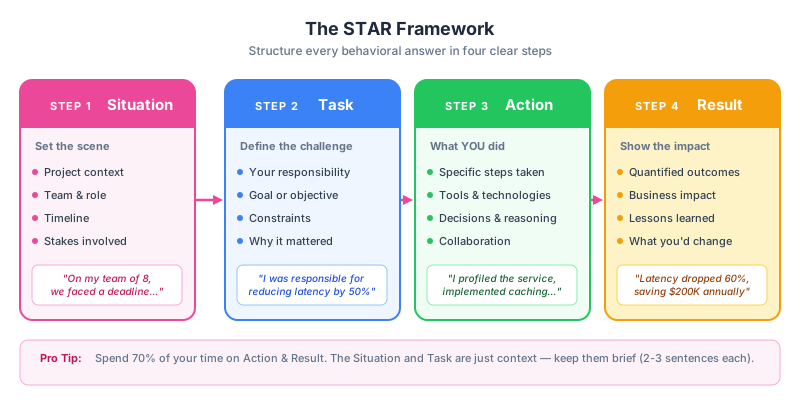
The Formula: S-T-A-R
Situation - Set the scene in two to three sentences. Where were you? What was the context?
Task - What was your specific responsibility? What needed to happen?
Action - What did you do? This is the heart of your answer. Use "I", not "we".
Result - What was the measurable outcome? Quantify it. What did you learn?
Example 1: Technical Challenge
Situation: Our payment service was experiencing 3-second latency spikes during peak hours, causing a 12% drop in checkout completions.
Task: As the tech lead, I needed to diagnose and fix the issue within our two-week sprint without disrupting the live system.
Action: I profiled the service and discovered N+1 database queries in the order validation path. I redesigned the data access layer to use batch queries, added Redis caching for frequently accessed product data, and implemented circuit breakers to prevent cascade failures.
Result: Latency dropped from 3 seconds to 180 milliseconds. Checkout completion rates recovered fully, adding an estimated £2.1 million in annual revenue. The pattern became our team's standard for all high-traffic services.
Example 2: Conflict Resolution
Discussion
Sign in to join the discussion