AI EducademyAIEducademy
🌳

KI-Grundlagen

🌱
AI Seeds

Starte bei null

🌿
AI Sprouts

Fundament aufbauen

🌳
AI Branches

In der Praxis anwenden

🏕️
AI Canopy

In die Tiefe gehen

🌲
AI Forest

KI meistern

🔨

KI-Meisterschaft

✏️
AI Sketch

Starte bei null

🪨
AI Chisel

Fundament aufbauen

⚒️
AI Craft

In der Praxis anwenden

💎
AI Polish

In die Tiefe gehen

🏆
AI Masterpiece

KI meistern

🚀

Karrierebereit

🚀
Interview-Startrampe

Starte deine Reise

🌟
Verhaltensinterview-Meisterschaft

Soft Skills meistern

💻
Technische Interviews

Die Coding-Runde bestehen

🤖
AI- & ML-Interviews

ML-Interview meistern

🏆
Angebot & Karriere

Das beste Angebot sichern

Alle Programme anzeigen→

Labor

7 Experimente geladen
🧠Neuronales Netz Spielplatz🤖KI oder Mensch?💬Prompt Labor🎨Bildgenerator😊Stimmungsanalyse💡Chatbot-Baukasten⚖️Ethik-Simulator
🎯ProbeinterviewLabor betreten→
LernreiseBlog
🎯
Über uns

KI-Bildung für alle zugänglich machen, überall

❓
FAQ

Common questions answered

✉️
Contact

Get in touch with us

⭐
Open Source

Öffentlich auf GitHub entwickelt

Loslegen
AI EducademyAIEducademy

MIT-Lizenz. Open Source

Lernen

  • Programme
  • Lektionen
  • Labor

Community

  • GitHub
  • Mitwirken
  • Verhaltenskodex
  • Über uns
  • FAQ

Unterstützung

  • Kauf mir einen Kaffee ☕
  • Nutzungsbedingungen
  • Datenschutzerklärung
  • Kontakt
KI & Engineering Programme›🌳 AI Branches›Lektionen›Computer Vision
👁️
AI Branches • Fortgeschritten⏱️ 18 Min. Lesezeit

Computer Vision

Computer Vision - How AI Learns to See the World

You glance at a photo and instantly know it shows a dog on a beach. For a computer, that same image is nothing more than a giant grid of numbers. Computer vision is the branch of AI that teaches machines to extract meaning from those numbers - and it is already reshaping industries around you.

How Computers "See"

When you look at a photograph, your brain instantly recognises shapes, colours, and depth. A computer has none of that intuition. Instead, it works with raw numbers.

A digital image is a grid of pixels. Each pixel stores colour values - typically three channels: red, green, and blue (RGB). A 1920 × 1080 HD image contains over two million pixels, each with three values ranging from 0 to 255. Multiply those together and even a single frame contains millions of numbers.

Diagram showing an image broken into a pixel grid with RGB channels
Every image is just a grid of numbers across red, green, and blue channels.

Resolution determines how much detail the grid captures. Higher resolution means more pixels and richer detail - but also far more data for the AI to process. A 4K image has four times the pixels of HD, which means four times the computational cost.

Grayscale images have just one channel (brightness), while some specialised formats - like satellite imagery or medical scans - may have dozens of channels capturing wavelengths invisible to the human eye.

🤯

The human eye can distinguish roughly 10 million colours. A standard 8-bit RGB image can represent over 16.7 million unique colour combinations - more than we can actually perceive!

Convolutional Neural Networks (CNNs)

Early attempts at computer vision relied on hand-crafted rules - "look for edges here, match this template there." These brittle approaches failed whenever the scene changed. Modern systems use Convolutional Neural Networks (CNNs), which learn their own rules from thousands of labelled examples.

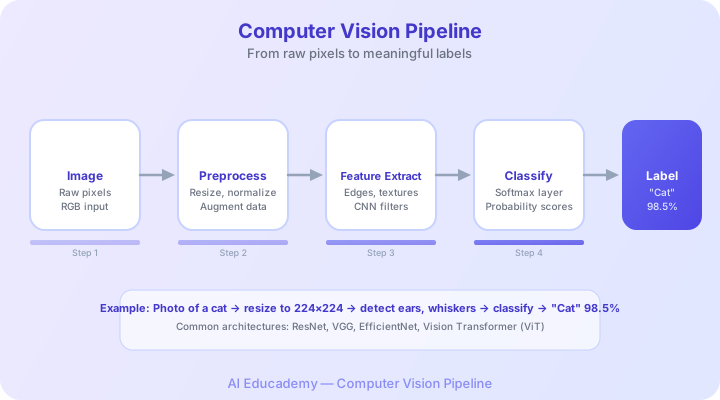
Think of a CNN as an assembly line of pattern detectors, each layer building on the one before it:

  1. Convolutional layers slide small filters across the image, detecting simple patterns like edges, corners, and textures.
  2. Pooling layers shrink the data down, keeping only the most important signals and discarding redundant detail.
  3. Deeper convolutional layers combine those simple patterns into more complex features - eyes, wheels, letters.
Lektion 1 von 140% abgeschlossen
←Zurück zum Programm

Discussion

Sign in to join the discussion

Bearbeitung vorschlagen
  • Fully connected layers pull all the features together to make a final decision - "this is a cat" or "this is a tumour."
  • The beauty is that nobody programmes these filters by hand. The network learns them during training, starting from random noise and gradually sharpening into useful detectors.

    🤔
    Think about it:

    When you learn to recognise a friend's face, you do not memorise every pixel - you pick up on key features like eye shape, hairstyle, and expression. CNNs do something remarkably similar. What features do you think a CNN would learn first?

    Classification, Detection, and Segmentation

    Computer vision tackles three progressively harder tasks:

    | Task | Question it answers | Example | |------|-------------------|---------| | Image classification | What is in this image? | "This X-ray shows pneumonia." | | Object detection | What is in this image and where? | Drawing boxes around every pedestrian in a street scene. | | Semantic segmentation | Which pixels belong to which object? | Colouring every pixel of a road, pavement, car, and sky differently. |

    Self-driving cars need all three simultaneously - classifying objects, locating them precisely, and understanding the full scene pixel by pixel.

    Each task requires progressively more computational power and training data. Classification was largely solved by 2015; real-time segmentation on video remains an active area of research today.

    🧠Kurzer Check

    Which computer vision task assigns a label to every individual pixel in an image?

    Real-World Applications

    Computer vision is already embedded in industries you might not expect:

    • Tesla Autopilot uses eight cameras and vision-based AI to detect lanes, traffic lights, and obstacles in real time - processing millions of frames per journey.
    • Medical imaging - AI models now match or exceed radiologists at spotting early-stage breast cancer in mammograms, sometimes catching what six human experts missed.
    • Quality control - factories use vision systems to inspect thousands of products per minute, catching defects far too subtle or fast for human inspectors.
    • Agriculture - drones with computer vision identify diseased crops across vast fields, enabling targeted treatment that reduces pesticide use by up to 90%.
    • Retail - Amazon Go stores use computer vision to track which products shoppers pick up, enabling checkout-free shopping.
    🤯

    Google's DeepMind developed an AI that can detect over 50 eye diseases from retinal scans as accurately as world-leading ophthalmologists - in seconds rather than weeks.

    Ethical Concerns

    Computer vision is powerful, but it raises serious questions that society is still grappling with:

    • Surveillance - facial recognition enables mass tracking of citizens. Several cities, including San Francisco and parts of the EU, have banned or restricted its use by police.
    • Bias - landmark studies by Joy Buolamwini at MIT showed that commercial facial recognition systems were significantly less accurate for darker-skinned faces and women, because training data has historically over-represented lighter-skinned males.
    • Consent - should your face be scanned without your knowledge in shops, airports, or public spaces? Many countries are still drafting legislation to address this.
    • Deepfakes - AI-generated fake images and videos can spread misinformation and damage reputations, making visual evidence less trustworthy.
    🤔
    Think about it:

    Imagine a school installs facial recognition cameras to take attendance automatically. What are the benefits? What could go wrong? Would you be comfortable with this system?

    🧠Kurzer Check

    Why do some facial recognition systems perform worse on certain demographic groups?

    Key Takeaways

    • Images are grids of pixel values across colour channels - computers see numbers, not pictures.
    • CNNs learn to extract features automatically through training, starting from edges and building up to complex objects.
    • Classification, detection, and segmentation represent increasing levels of visual understanding.
    • Computer vision drives breakthroughs from healthcare diagnostics to autonomous vehicles and precision agriculture.
    • Bias in training data and surveillance concerns demand careful, ethical deployment - technology alone is never enough without responsible governance.
    🧠Kurzer Check

    In a CNN, what is the purpose of pooling layers?