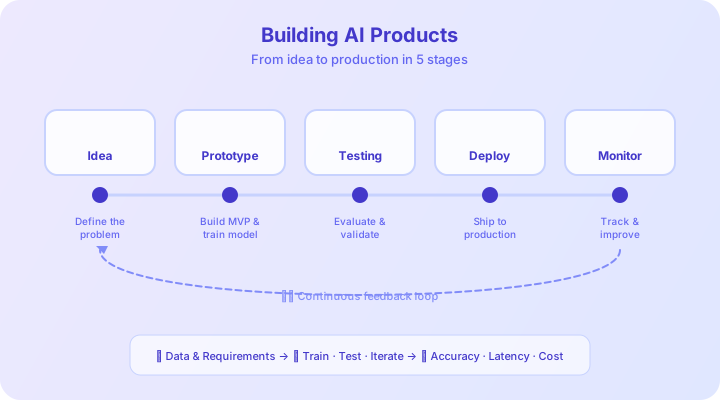
Esta lição foi traduzida automaticamente para português e ainda não foi revisada por uma pessoa. Se algo parecer estranho, a versão em inglês é a definitiva.
A maioria dos projetos de IA nunca chega à produção. A lacuna entre um notebook de trabalho e um produto confiável é enorme - abrangendo infraestrutura, monitoramento, processos de equipe e gerenciamento de custos. Esta lição cobre tudo que você precisa para preencher essa lacuna com sucesso.
Antes de escrever uma única linha de código, faça a pergunta mais importante no desenvolvimento de produtos de IA: esse problema realmente precisa de IA? A resposta é “não” com mais frequência do que você imagina.
IA é a escolha certa quando:
IA é a escolha errada quando:
A regra 10x: Se a IA não fornecer uma melhoria de pelo menos 10x em relação à alternativa sem IA em termos de velocidade, precisão ou custo, a complexidade operacional de manter um sistema de ML raramente vale a pena.
Nem todo problema precisa de um grande modelo de linguagem. Escolher o tipo de modelo errado é um dos erros mais caros no desenvolvimento de produtos de IA. Combine a ferramenta com a tarefa:
| Tipo de problema | Melhor abordagem | Exemplo | |---|---|---| | Previsão tabular | Árvores com gradiente aumentado (XGBoost, LightGBM) | Previsão de rotatividade, preços | | Tarefas de imagem | CNNs ou transformadores de visão | Inspeção de qualidade, OCR | | Classificação de texto | BERT ajustado ou LLMs menores | Análise de sentimento, roteamento | | Texto gerativo | LLMs (GPT, Claude, Llama) | Chatbots, geração de conteúdo | | Séries temporais | Profeta, N-BEATS ou CNNs temporais | Previsão de demanda |
Para uma tarefa tabular de previsão de rotatividade com 50.000 linhas de dados estruturados, qual abordagem normalmente é mais eficaz?
Inicie sessão para participar na discussão
A velocidade da iteração sempre supera a perfeição. Equipes que passam meses construindo antes de validar desperdiçam recursos com base em suposições. Use esta estrutura para validar ideias rapidamente:
Dia 1 - Escopo e dados. Defina a métrica única que importa. Isso não é negociável - sem uma métrica de sucesso clara, você não pode avaliar nada. Reúna ou simule o conjunto de dados mínimo viável. Não limpe perfeitamente - apenas o suficiente para ser utilizável.
Dia 2 - Crie e teste. Use um modelo ou API existente. Envolva-o em uma interface mínima (Streamlit, Gradio ou uma API simples). Obtenha algo com o qual um humano possa interagir.
Dia 3 - Validar. Apresente-o a usuários ou partes interessadas reais - não a colegas que serão educados, mas a pessoas que realmente pagariam pela solução. Meça em relação à sua métrica de sucesso. Decida: matar, girar ou investir.
Pense no último projeto de IA em que você trabalhou. Quanto tempo demorou para que a primeira versão chegasse ao usuário? Um sprint de 3 dias poderia ter validado a ideia central mais rapidamente?
O ML de produção exige práticas operacionais rigorosas que a maioria dos cientistas de dados nunca aprende em ambientes acadêmicos. O princípio básico é aparentemente simples: versionar tudo, automatizar tudo. A execução, no entanto, requer disciplina e as ferramentas certas.
Qual versão:
Automação de pipeline:
A pesquisa do Google descobriu que apenas cerca de 5% do código do sistema de ML do mundo real é o modelo real. Os 95% restantes são pipelines de dados, atendendo infraestrutura, monitoramento e gerenciamento de configuração.
A implantação de um modelo não é a linha de chegada - é a linha de partida. Sem o monitoramento adequado, os modelos se degradam silenciosamente e, quando alguém percebe, o dano já está feito.
Desvio de dados - A distribuição dos dados de entrada muda com o tempo. Um modelo treinado em dados de compras pré-pandemia falhará nos padrões pós-pandemia. Monitore continuamente as distribuições de recursos e alerte sobre mudanças estatisticamente significativas usando testes como o teste de Kolmogorov-Smirnov ou o Índice de Estabilidade Populacional.
Degradação do modelo - Mesmo sem desvio de dados, o desempenho do modelo pode diminuir à medida que o mundo real muda. O comportamento do usuário evolui, os concorrentes mudam o mercado e os padrões sazonais alteram os resultados. Acompanhe continuamente a confiança nas previsões, as taxas de erro e as métricas de negócios.
Principais práticas de monitoramento:
O que é 'desvio de dados' no contexto de sistemas de ML de produção?
Os custos de inferência de IA podem aumentar rapidamente. Decisões inteligentes de arquitetura os mantêm gerenciáveis.
Estratégias práticas:
Qual estratégia de otimização de custos envolve o uso de diferentes modelos baseados na complexidade da consulta?
Se você recebesse um orçamento de £ 10.000/mês para inferência de IA, como você o alocaria? Considere quais partes do seu sistema precisam de respostas em tempo real versus processamento em lote e onde o cache pode eliminar a computação redundante.
Construir produtos de IA é fundamentalmente um desafio de produto e engenharia, não apenas um desafio de aprendizado de máquina. Mantenha estes princípios por perto:
Os melhores produtos de IA são desenvolvidos por equipes que entendem profundamente a tecnologia e os problemas de negócios. A excelência técnica sem pensar no produto leva a demonstrações impressionantes que ninguém usa.