🔤
AI Sketch • Débutant⏱️ 15 min de lecture
Strings & Pattern Matching — How AI Reads Text
Strings & Pattern Matching
Every time you type a search query, send a message, or ask an AI a question — strings are being processed. Understanding how they work under the hood unlocks both interview success and AI intuition.
Strings Under the Hood
A string is just a character array with special rules.
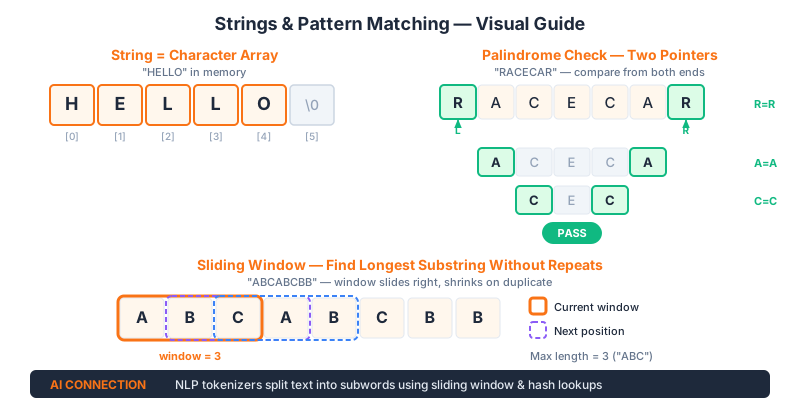
Key facts:
- Immutable in most languages (Java, Python, Go) — every "change" creates a new string
- Indexed — access any character in O(1)
- Encoded — UTF-8, UTF-16, ASCII affect how characters map to bytes
💡
In Python, s = "hello" then s[0] = "H" throws an error. Strings are immutable. Use s = "H" + s[1:] or list(s) to modify.
Pattern 1: String Reversal
Reverse a string in-place using two pointers.
Visual walkthrough — "HELLO":
| Step | L ptr | R ptr | Action | Result | |------|-------|-------|--------|--------| | 1 | H (0) | O (4) | Swap | OELLH | | 2 | E (1) | L (3) | Swap | OLLEH | | 3 | L=L | — | Done | OLLEH |
def reverse_string(s: list[str]) -> None:
    left, right = 0, len(s) - 1
    while left < right:
        s[left], s[right] = s[right], s[left]
        left += 1
        right -= 1
Time: O(n) | Space: O(1) — no extra memory needed.
Pattern 2: Palindrome Check
Is the string the same forwards and backwards?
Two-pointer approach — compare from both ends, move inward:
- Set
left = 0,right = len - 1 - If
s[left] != s[right]→ not a palindrome - Move both pointers inward
- If they meet → palindrome confirmed
def is_palindrome(s: str) -> bool:
    left, right = 0, len(s) - 1
    while left < right:
        if s[left] != s[right]:
            return False
        left += 1
        right -= 1
    return True
🤔
Think about it:
How would you handle "A man, a plan, a canal: Panama"? You need to skip non-alphanumeric characters and ignore case. Add while left < right and not s[left].isalnum(): left += 1 before each comparison.
Pattern 3: Anagram Detection
Are two strings anagrams? (Same characters, different order)
Hash map approach — count character frequencies:
def is_anagram(s: str, t: str) -> bool:
    if len(s) != len(t):
        return False
    count = {}
    for c in s:
        count[c] = count.get(c, 0) + 1
    for c in t:
        count[c] = count.get(c, 0) - 1
        if count[c] < 0:
            return False
    return True
| | "listen" | "silent" | |---|----------|----------| | l | 1 | 1 | | i | 1 | 1 | | s | 1 | 1 | | t | 1 | 1 | | e | 1 | 1 | | n | 1 | 1 |
All counts zero → anagram confirmed.
Pattern 4: Sliding Window
Find the longest substring without repeating characters.
The technique: Maintain a "window" of valid characters. Expand right, shrink left when a duplicate is found.
Walkthrough with "ABCABCBB":
| Step | Window | Seen | Length | |------|--------|------|--------| | 1 | A | {A} | 1 | | 2 | AB | {A,B} | 2 | | 3 | ABC | {A,B,C} | 3 | | 4 | A is duplicate → shrink → BCA | {B,C,A} | 3 | | 5 | B is duplicate → shrink → CAB | {C,A,B} | 3 |
Answer: 3 (any of "ABC", "BCA", or "CAB")
def length_of_longest_substring(s: str) -> int:
    seen = {}
    left = max_len = 0
    for right, char in enumerate(s):
        if char in seen and seen[char] >= left:
            left = seen[char] + 1
        seen[char] = right
        max_len = max(max_len, right - left + 1)
    return max_len
💡
The sliding window pattern solves dozens of substring problems. Key insight: if expanding the window breaks a condition, shrink from the left until the condition holds again.
The AI Connection: Tokenization
Before any NLP model (GPT, BERT, LLaMA) processes text, it tokenizes — splits text into sub-word pieces using techniques built on the patterns above.
How BPE (Byte Pair Encoding) works:
- Start with individual characters:
["h", "e", "l", "l", "o"] - Count adjacent pairs — most frequent pair:
("l", "l") - Merge:
["h", "e", "ll", "o"] - Repeat until vocabulary size reached
This uses:
- Frequency counting (hash maps) to find common pairs
- Sliding window to scan adjacent characters
- String manipulation to merge tokens
🤯
GPT-4's tokenizer has ~100,000 tokens. The word "indescribable" might become ["in", "desc", "rib", "able"] — 4 tokens. Common words like "the" are a single token. This is why AI models "think" in tokens, not words!
Complexity Summary
| Pattern | Time | Space | Key Technique | |---------|------|-------|---------------| | String reversal | O(n) | O(1) | Two pointers | | Palindrome check | O(n) | O(1) | Two pointers | | Anagram detection | O(n) | O(1)* | Hash map counting | | Sliding window | O(n) | O(k) | Hash set + two pointers |
*O(1) because character set is fixed (26 letters)
🤔
Think about it:
Why is sliding window O(n) and not O(n²)? Because each character is added and removed from the window at most once. The left pointer only moves forward, never backwards — so the total work across all steps is linear.
Lesson 2 of 30 of 3 completed