AI EducademyAIEducademy
🌳

Fundamentos de IA

🌱
AI Seeds

Empieza desde cero

🌿
AI Sprouts

Construye bases

🌳
AI Branches

Aplica en la práctica

🏕️
AI Canopy

Profundiza

🌲
AI Forest

Domina la IA

🔨

Maestría en IA

✏️
AI Sketch

Empieza desde cero

🪨
AI Chisel

Construye bases

⚒️
AI Craft

Aplica en la práctica

💎
AI Polish

Profundiza

🏆
AI Masterpiece

Domina la IA

🚀

Preparación Profesional

🚀
Plataforma de Entrevistas

Comienza tu camino

🌟
Dominio Conductual

Domina las habilidades blandas

💻
Entrevistas Técnicas

Supera la ronda de código

🤖
Entrevistas de IA y ML

Dominio en entrevistas de ML

🏆
Oferta y Más Allá

Consigue la mejor oferta

Ver Todos los Programas→

Laboratorio

7 experimentos cargados
🧠Playground de Red Neuronal🤖¿IA o Humano?💬Laboratorio de Prompts🎨Generador de Imágenes😊Analizador de Sentimiento💡Constructor de Chatbots⚖️Simulador de Ética
🎯Entrevista simuladaEntrar al Laboratorio→
ViajeBlog
🎯
Acerca de

Hacer la educación en IA accesible para todos, en todas partes

❓
Preguntas Frecuentes

Common questions answered

✉️
Contact

Get in touch with us

⭐
Open Source

Construido de forma abierta en GitHub

Empezar
AI EducademyAIEducademy

Licencia MIT. Open Source

Aprender

  • Académicos
  • Lecciones
  • Laboratorio

Comunidad

  • GitHub
  • Contribuir
  • Código de Conducta
  • Acerca de
  • Preguntas Frecuentes

Soporte

  • Invítame a un Café ☕
  • Términos de Servicio
  • Política de Privacidad
  • Contacto
Académicos de IA e Ingeniería›🌱 AI Seeds›Lecciones›¿Qué es la IA? Una Introducción Amigable
🤖
AI Seeds • Principiante⏱️ 10 min de lectura

¿Qué es la IA? Una Introducción Amigable

What is AI? A Friendly Introduction 🤖

You've probably heard the term Artificial Intelligence - or AI - dozens of times this week. It's in the news, it's in adverts, and people at work won't stop talking about it.

But what actually is it? Let's clear up the mystery.


🌅 You Already Use AI Every Day

Before we define anything, here's a surprise: you're already an AI user. You have been for years.

  • Face unlock on your phone? That's AI recognising your face.
  • Netflix suggesting a film you end up loving? AI studied your watching habits.
  • Google Translate turning a French menu into English? AI is doing the translation.
  • Siri or Alexa answering your questions? AI is understanding your voice.

AI isn't some futuristic robot. It's software that's already woven into your daily routine.

🤯

The average person interacts with AI-powered systems between 20 and 30 times per day - from unlocking their phone in the morning to getting a playlist recommendation at night.


🤖 So What IS Artificial Intelligence?

Here's the simplest definition:

Artificial Intelligence is software that can learn from experience and make decisions, rather than just following fixed rules.

Let's make that concrete with an example.

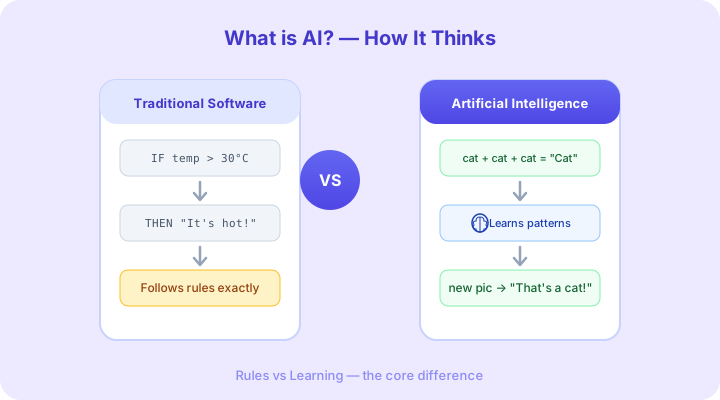
Regular Software (Fixed Rules)

A traditional calculator follows exact rules: "If the user presses 2 + 2, display 4." It will never learn, never improve, never do anything it wasn't told to do. It's brilliant at maths but can't do anything else.

AI Software (Learning from Data)

A spam filter in your email doesn't have a fixed list of spam words. Instead, it learns by looking at millions of emails that humans have marked as spam or not spam. Over time, it spots new patterns that no programmer ever wrote rules for. It gets smarter with experience.

That ability to learn and improve is what separates AI from regular software.

Side-by-side comparison: traditional software following a rigid flowchart of rules versus AI software learning from examples and improving over time
Traditional software follows fixed rules. AI learns from data and improves with experience.
Lección 1 de 170% completado
←Volver al programa

Discussion

Sign in to join the discussion

Sugerir una edición a esta lección
🤔
Think about it:

Think about your email inbox. You probably haven't manually marked spam in ages, yet your spam folder catches new tricks from scammers every week. That's AI quietly learning in the background. Can you think of another example where software seems to get better on its own?


🎯 Two Types of AI

Not all AI is created equal. Scientists generally talk about two types:

Narrow AI (What We Have Today)

Narrow AI is designed to do one specific task very well. Your phone's face recognition is narrow AI - it can identify faces, but it can't write a poem or drive a car.

Every AI you interact with today is narrow AI:

  • Spotify's music recommendations
  • Autocorrect on your keyboard
  • Fraud detection at your bank
  • Voice assistants like Siri

General AI (Still Science Fiction)

General AI would be a machine that can think, reason, and learn any task a human can - and possibly better. It would switch between writing music, diagnosing diseases, and having a philosophical debate, just like a person can.

This doesn't exist yet. Some researchers think it might take decades. Others think it may never happen. The AI you see in films like Ex Machina or Her is general AI - impressive but fictional for now.

🧠Verificación Rápida

What is the key difference between narrow AI and general AI?


🌍 Where Is AI Used Today?

AI is everywhere. Here are some examples you might not have thought about:

| Area | How AI Helps | |------|-------------| | Healthcare | Spotting early signs of cancer in medical scans | | Agriculture | Drones identifying which crops need water | | Banking | Detecting fraudulent transactions in milliseconds | | Retail | Predicting which products will sell out next week | | Transport | Optimising delivery routes for thousands of parcels | | Entertainment | Creating personalised playlists and recommendations |

The common thread? AI is brilliant at finding patterns in large amounts of data - far faster than any human could.

🤯

AI systems can now detect certain types of cancer from medical images with accuracy matching - and sometimes exceeding - that of experienced doctors. In one study, an AI identified breast cancer in mammograms 11.5% more accurately than human radiologists.

🧠Verificación Rápida

Which of these best describes what AI is?


🔑 Key Takeaways

  • AI is software that learns from data rather than just following fixed rules
  • You already use AI every day - face unlock, recommendations, translations, voice assistants
  • Narrow AI (what exists today) does one task well
  • General AI (science fiction for now) would match human-level intelligence across all tasks
  • AI excels at spotting patterns in enormous datasets
💡

AI is a tool - like a hammer or a calculator. It's incredibly powerful when used well, but it doesn't "think" the way humans do. Throughout this programme, we'll explore what AI can and can't do, so you can use it confidently and responsibly.

🧠Verificación Rápida

Which of these is an example of AI in everyday life?


What's Next?

Now that you know what AI is, the next lesson dives into how machines actually learn. We'll explore the fascinating process that turns raw data into intelligent behaviour.