Esta lección se tradujo automáticamente al español y aún no ha sido revisada por una persona. Si algo suena raro, la versión en inglés es la definitiva.
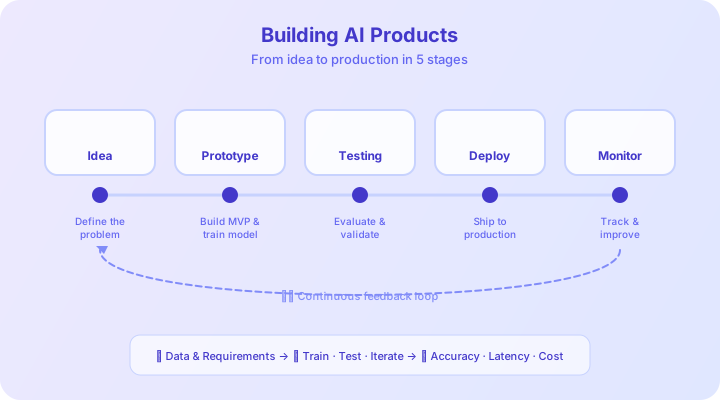
La mayoría de los proyectos de IA nunca llegan a producción. La brecha entre una computadora portátil que funciona y un producto confiable es enorme: abarca infraestructura, monitoreo, procesos de equipo y gestión de costos. Esta lección cubre todo lo que necesita para cerrar esa brecha con éxito.
Antes de escribir una sola línea de código, formule la pregunta más importante en el desarrollo de productos de IA: ¿este problema realmente necesita IA? La respuesta es "no" más a menudo de lo que piensas.
La IA es la elección correcta cuando:
La IA es la elección equivocada cuando:
La regla de 10x: Si la IA no ofrece al menos una mejora de 10x con respecto a la alternativa sin IA en cuanto a velocidad, precisión o costo, la complejidad operativa de mantener un sistema de aprendizaje automático rara vez vale la pena.
No todos los problemas necesitan un modelo de lenguaje grande. Elegir el tipo de modelo incorrecto es uno de los errores más costosos en el desarrollo de productos de IA. Haga coincidir la herramienta con la tarea:
| Tipo de problema | Mejor enfoque | Ejemplo | |---|---|---| | Predicción tabular | Árboles potenciados con gradiente (XGBoost, LightGBM) | Predicción de abandono, precios | | Tareas de imagen | CNN o transformadores de visión | Inspección de calidad, OCR | | Clasificación de textos | BERT ajustado o LLM más pequeños | Análisis de sentimiento, enrutamiento | | Texto generativo | LLMs (GPT, Claude, Llama) | Chatbots, generación de contenidos | | Serie temporal | Prophet, N-BEATS o CNN temporales | Previsión de la demanda |
Para una tarea de predicción de abandono tabular con 50.000 filas de datos estructurados, ¿qué enfoque suele ser más eficaz?
Inicia sesión para unirte al debate
La velocidad de iteración siempre supera a la perfección. Los equipos que pasan meses construyendo antes de validar desperdician recursos en suposiciones. Utilice este marco para validar ideas rápidamente:
Día 1: Alcance y datos. Defina la métrica única que importa. Esto no es negociable: sin una métrica de éxito clara, no se puede evaluar nada. Reúna o simule el conjunto de datos mínimo viable. No lo limpie perfectamente, sólo lo suficiente para que sea utilizable.
Día 2: compilación y prueba. Utilice un modelo o API existente. Envuélvalo en una interfaz mínima (Streamlit, Gradio o una API simple). Consigue algo con lo que un humano pueda interactuar.
Día 3: Validar. Póngalo frente a usuarios o partes interesadas reales: no colegas que sean educados, sino personas que realmente pagarían por la solución. Mida su métrica de éxito. Decide: matar, girar o invertir.
Piensa en el último proyecto de IA en el que trabajaste. ¿Cuánto tiempo llevó presentar la primera versión a un usuario? ¿Podría un sprint de 3 días haber validado la idea central más rápido?
El aprendizaje automático de producción requiere prácticas operativas rigurosas que la mayoría de los científicos de datos nunca aprenden en entornos académicos. El principio básico es engañosamente simple: versione todo, automatice todo. La ejecución, sin embargo, requiere disciplina y las herramientas adecuadas.
Qué versión:
Automatización de tuberías:
La investigación de Google encontró que solo alrededor del 5% del código del sistema ML del mundo real es el modelo real. El 95% restante son canalizaciones de datos, infraestructura de servicio, monitoreo y gestión de configuración.
Implementar un modelo no es la línea de meta, sino la línea de partida. Sin un seguimiento adecuado, los modelos se degradan silenciosamente y, cuando alguien se da cuenta, el daño ya está hecho.
Deriva de datos: la distribución de los datos de entrada cambia con el tiempo. Un modelo formado con datos de compras anteriores a la pandemia fracasará en los patrones posteriores a la pandemia. Supervise las distribuciones de características de forma continua y alerte sobre cambios estadísticamente significativos mediante pruebas como la prueba de Kolmogorov-Smirnov o el índice de estabilidad de la población.
Degradación del modelo: incluso sin desviación de datos, el rendimiento del modelo puede decaer a medida que cambia el mundo real. El comportamiento del usuario evoluciona, los competidores cambian el mercado y los patrones estacionales alteran los resultados. Realice un seguimiento continuo de la confianza en las predicciones, las tasas de error y las métricas comerciales.
Prácticas clave de monitoreo:
¿Qué es la ”deriva de datos” en el contexto de los sistemas de aprendizaje automático de producción?
Los costos de inferencia de la IA pueden dispararse rápidamente. Las decisiones arquitectónicas inteligentes las mantienen manejables.
Estrategias prácticas:
¿Qué estrategia de optimización de costos implica el uso de diferentes modelos según la complejidad de la consulta?
Si le dieran un presupuesto de £ 10 000 al mes para la inferencia de IA, ¿cómo lo asignaría? Considere qué partes de su sistema necesitan respuestas en tiempo real versus procesamiento por lotes, y dónde el almacenamiento en caché podría eliminar el cálculo redundante.
La creación de productos de IA es fundamentalmente un desafío de ingeniería y de producto, no solo de aprendizaje automático. Mantenga estos principios cerca:
Los mejores productos de IA son creados por equipos que comprenden profundamente tanto la tecnología como el problema empresarial. La excelencia técnica sin pensar en el producto conduce a demostraciones impresionantes que nadie usa.