📊
AI Sketch • Beginner⏱️ 15 min read
Arrays & Hashing — The Building Blocks of AI
Arrays & Hashing
Every AI system — from recommendation engines to search indexes — is built on two primitives: arrays and hash maps. Master these and you master the foundation.
How Arrays Work
An array stores elements in contiguous memory — each slot is one step from the next.
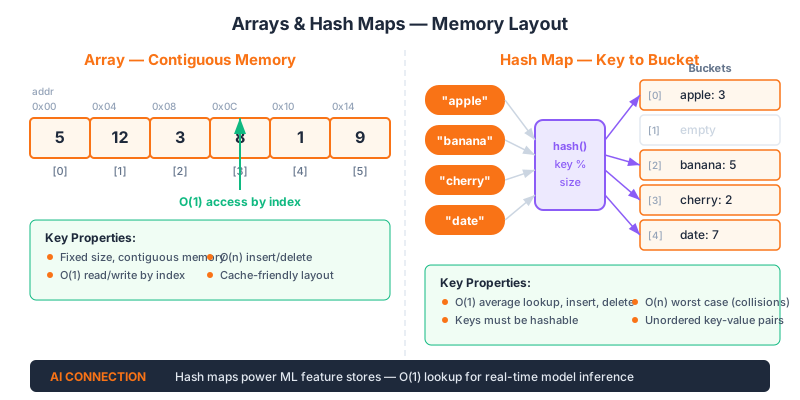
Key characteristics:
- O(1) access — jump directly to any index
- O(n) insert/delete — shifting elements is expensive
- Cache-friendly — sequential memory = fast CPU reads
- Fixed size (in most languages) — must know capacity upfront
💡
Arrays are the backbone of tensors in machine learning. A 2D array is a matrix, a 3D array is a tensor — the core data structure of every neural network.
How Hash Maps Work
A hash map converts a key into an index using a hash function, then stores the value in that bucket.
The process:
- Input:
"apple"(key) - Hash:
hash("apple") % size→ bucket0 - Store: bucket
0={apple: 3} - Lookup: O(1) average — go straight to the bucket
Key characteristics:
- O(1) average lookup, insert, delete
- O(n) worst case — when all keys collide into one bucket
- Unordered — no guaranteed iteration order
- Keys must be hashable — immutable types work best
🤔
Think about it:
Why can't you use a list as a dictionary key in Python? Because lists are mutable — if you change the list after hashing, the hash value changes but the bucket doesn't, breaking the lookup.
Pattern 1: Two Sum
Given an array and a target, find two numbers that add up to the target.
Brute force: Check every pair → O(n²)
Hash map approach: For each number, check if target - num exists → O(n)
Step by step with nums = [2, 7, 11, 15], target = 9:
| Step | Current | Need (9 - current) | In Map? | Action |
|------|---------|---------------------|---------|--------|
| 1 | 2 | 7 | No | Store {2: 0} |
| 2 | 7 | 2 | Yes! | Return [0, 1] |
💡
This pattern — "store what you've seen, check what you need" — appears in dozens of interview problems.
Pattern 2: Frequency Counting
Count how often each element appears.
def frequency_count(nums):
    freq = {}
    for num in nums:
        freq[num] = freq.get(num, 0) + 1
    return freq

# [1, 2, 2, 3, 3, 3] → {1: 1, 2: 2, 3: 3}
Used in:
- Top K Frequent Elements — count then sort by frequency
- Valid Anagram — compare character frequencies
- Group Anagrams — group words with same sorted characters
Pattern 3: Grouping by Key
Group anagrams:
["eat","tea","tan","ate","nat","bat"]
Strategy: Sort each word → use sorted version as hash key.
| Original | Sorted (Key) | Group | |----------|-------------|-------| | "eat" | "aet" | ["eat", "tea", "ate"] | | "tan" | "ant" | ["tan", "nat"] | | "bat" | "abt" | ["bat"] |
The AI Connection: Feature Stores
In production ML systems, feature stores use hash maps at their core:
- User ID → feature vector — instant lookup for real-time recommendations
- Product ID → embeddings — similarity search in recommendation engines
- Cache layer — avoid recomputing expensive features
🤯
Netflix's recommendation engine performs millions of hash map lookups per second to match users with content. Each user's viewing history is stored as a hash map of {movie_id: rating}, enabling O(1) feature retrieval during model inference.
Complexity Cheat Sheet
| Operation | Array | Hash Map | |-----------|-------|----------| | Access by index | O(1) | — | | Search by value | O(n) | O(1) avg | | Insert at end | O(1)* | O(1) avg | | Insert at start | O(n) | O(1) avg | | Delete | O(n) | O(1) avg | | Space | O(n) | O(n) |
*amortised for dynamic arrays
🤔
Think about it:
When would you choose an array over a hash map? When you need ordered data, cache performance, or minimal memory overhead. Hash maps trade space for speed — each entry has overhead for the hash, key, and pointer.
Lesson 1 of 30 of 3 completed