📚
AI Chisel • मध्यम⏱️ 20 मिनट पढ़ने का समय
Stacks & Queues — How AI Processes Sequences
Stacks & Queues — How AI Processes Sequences
Stacks and queues are the simplest data structures with the deepest impact. Every recursive call, every BFS, every undo operation — they all rely on these two.
Stack vs Queue: Visual Comparison
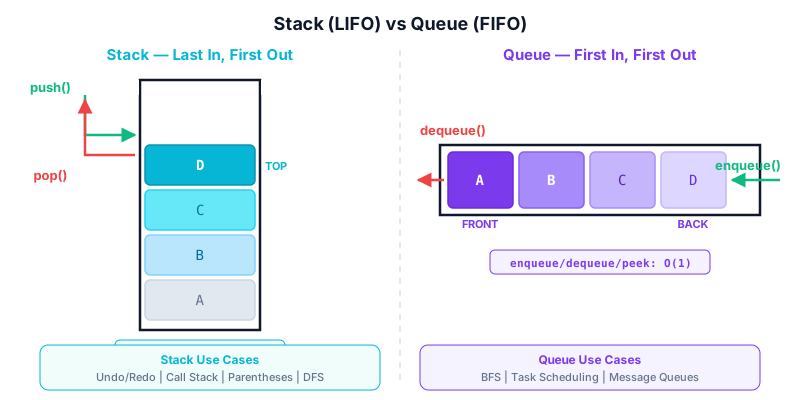
Stack — LIFO (Last In, First Out)
stack = []
stack.append(1)    # push
stack.append(2)
stack.append(3)
top = stack[-1]    # peek -> 3
val = stack.pop()  # pop -> 3
Queue — FIFO (First In, First Out)
from collections import deque

queue = deque()
queue.append(1)      # enqueue
queue.append(2)
queue.append(3)
front = queue[0]     # peek -> 1
val = queue.popleft() # dequeue -> 1
💡
Never use list.pop(0) for queues in Python — it's O(n) because it shifts all elements. Use collections.deque which gives O(1) popleft.
Classic Stack Patterns
Valid Parentheses
def is_valid(s):
    stack = []
    pairs = {')': '(', ']': '[', '}': '{'}

    for char in s:
        if char in pairs:
            if not stack or stack[-1] != pairs[char]:
                return False
            stack.pop()
        else:
            stack.append(char)

    return len(stack) == 0
Key stack problems
| Problem | Pattern | Key Insight | |---------|---------|-------------| | Valid parentheses | Match open/close | Stack stores openers | | Min stack | Auxiliary stack | Track min at each level | | Evaluate RPN | Operand stack | Pop two, compute, push result | | Daily temperatures | Monotonic stack | Next warmer day = next greater | | Largest rectangle in histogram | Monotonic stack | Maintain increasing heights |
The Monotonic Stack Pattern
The most powerful stack pattern in interviews. Maintain a stack where elements are always in increasing or decreasing order.
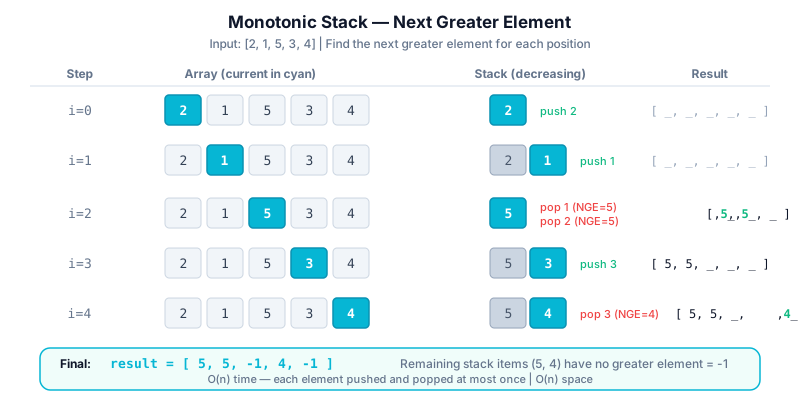
Next Greater Element
def next_greater_element(arr):
    n = len(arr)
    result = [-1] * n
    stack = []  # stores indices

    for i in range(n):
        # Pop all elements smaller than current
        while stack and arr[stack[-1]] < arr[i]:
            idx = stack.pop()
            result[idx] = arr[i]   # arr[i] is the next greater
        stack.append(i)

    return result

# Example: [2, 1, 5, 3, 4] -> [5, 5, -1, 4, -1]
🤔
Think about it:
Why is this O(n) and not O(n^2)? Each element enters the stack exactly once and leaves at most once. That's at most 2n operations, regardless of the while loop inside the for loop.
Monotonic stack variants
| Variant | Stack Order | Finds | |---------|-------------|-------| | Decreasing stack | Top is smallest | Next greater element | | Increasing stack | Top is largest | Next smaller element | | From right to left | Process backwards | Previous greater/smaller |
Queue Patterns
BFS with Queue
Already covered in the Trees & Graphs lesson — BFS is the canonical queue algorithm.
Sliding Window Maximum (Monotonic Deque)
The deque variant of monotonic stacks — maintain a decreasing deque of useful indices:
from collections import deque

def max_sliding_window(nums, k):
    dq = deque()  # stores indices, values are decreasing
    result = []

    for i in range(len(nums)):
        # Remove elements outside window
        while dq and dq[0] < i - k + 1:
            dq.popleft()

        # Maintain decreasing order
        while dq and nums[dq[-1]] <= nums[i]:
            dq.pop()

        dq.append(i)

        if i >= k - 1:
            result.append(nums[dq[0]])  # front is always the max

    return result
💡
Monotonic deque combines the sliding window and monotonic stack patterns. It's the most advanced queue pattern you'll see in interviews — and it runs in O(n).
AI Connection: Stacks & Queues in AI Systems
🤯
These simple structures power complex AI systems:
- Call Stack in Recursion: Every recursive neural network (Tree-LSTM, recursive parsing) relies on the call stack to process nested structures.
- Parser Stacks: Compilers and NLP parsers use stacks for shift-reduce parsing — pushing tokens and reducing them into grammar rules.
- Undo/Redo in Editors: AI-powered code editors (Copilot, Cursor) use dual stacks — one for undo, one for redo — to track edit history.
- Task Queues in ML Pipelines: Training job schedulers (Kubernetes, Celery) use priority queues to manage GPU allocation and batch processing order.
- Attention as Queue Processing: In autoregressive transformers, the KV-cache processes tokens in FIFO order, maintaining a sliding context window.
Quick Reference
| Data Structure | Access Pattern | Operations | Time | Use Case | |----------------|---------------|------------|------|----------| | Stack | LIFO | push, pop, peek | O(1) | Parentheses, DFS, undo | | Queue | FIFO | enqueue, dequeue, peek | O(1) | BFS, scheduling, streaming | | Monotonic Stack | Decreasing/Increasing | push, pop (conditional) | O(n) amortised | Next greater/smaller element | | Monotonic Deque | Decreasing window | push, pop both ends | O(n) amortised | Sliding window maximum |
Lesson 3 of 30 of 3 completed